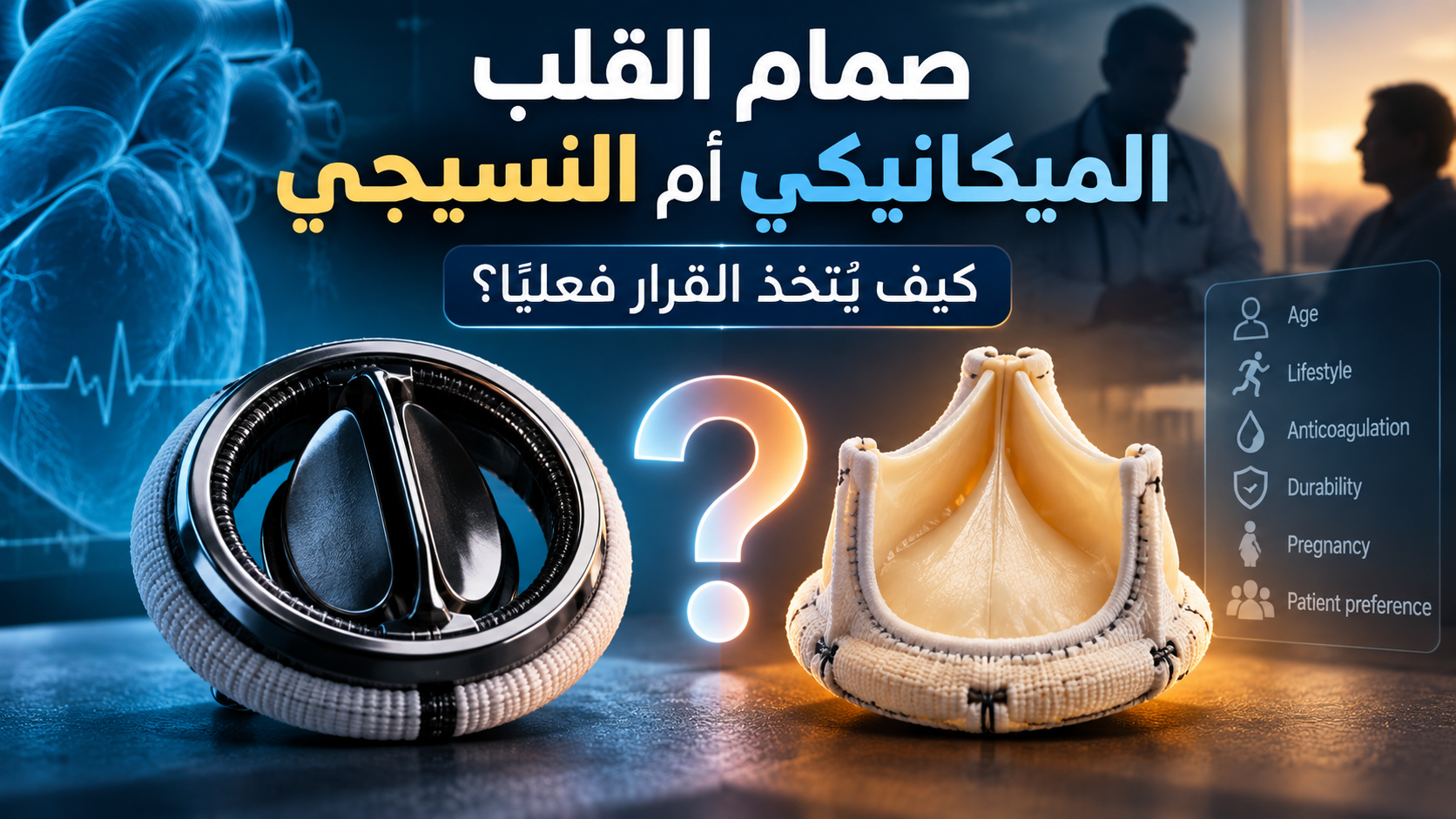
Mechanical or Tissue Heart Valve: How the Choice Is Actually Made
Introduction
When a heart valve is too damaged to repair, it must be replaced — and the patient is asked to take part in a decision that will shape the next few decades of their life. Mechanical valve, or tissue valve?
Patients often expect the surgeon to simply name the better one. There is no better one. There are two different sets of trade-offs, and the right answer depends on facts about the patient, not only about the valve.
First: can the valve be repaired instead?
Before choosing a replacement, the real first question is whether replacement is needed at all. Repair is usually preferable to replacement where it is achievable and durable — particularly for the mitral valve. Keeping your own tissue preserves the natural geometry of the ventricle, generally avoids lifelong anticoagulation, and carries a lower risk of prosthetic infection. If your surgeon says repair is possible, that is normally the better path.
This article is about the situation where repair is not possible.
The mechanical valve
Made from durable materials such as pyrolytic carbon, a mechanical valve is essentially permanent.
Advantage: it does not wear out. For most patients it will outlast them, and a second operation for valve degeneration is unlikely.
Cost: blood tends to clot on artificial surfaces, so a mechanical valve requires lifelong anticoagulation with warfarin — not aspirin, and not the newer direct oral anticoagulants, which are not suitable for mechanical valves. That means regular INR blood tests, attention to diet and interacting medication, and an increased bleeding risk for life. It also has implications for pregnancy, because warfarin can harm a developing baby.
Some patients also notice a faint clicking sound. Many stop noticing it; a few find it intrusive.
The tissue valve
Made from treated animal tissue — usually bovine pericardium or a porcine valve — a tissue valve behaves much more like a natural valve.
Advantage: it generally does not require long-term anticoagulation, so day-to-day life is simpler and bleeding risk is lower.
Cost: it degenerates with time. Leaflets gradually calcify and stiffen, and the valve eventually needs replacing. How long that takes depends heavily on age — and this is the single most important fact in the whole decision.
The key point most patients are not told: age drives durability
Tissue valves wear out much faster in young patients. The calcium metabolism of a young body attacks the tissue more aggressively. A tissue valve implanted in a patient in their seventies may well last the rest of their life. The same valve in a patient in their thirties may fail within a decade, sometimes sooner.
This is why the conversation differs so sharply by age:
- Older patients — a tissue valve is often the natural choice. Durability is likely to be sufficient, and avoiding warfarin matters more as bleeding and falls risk rises.
- Younger patients — the choice is genuinely difficult. A mechanical valve means warfarin for decades; a tissue valve probably means at least one more operation.
Other factors that shift the decision
- Pregnancy plans. A major consideration for younger women. Warfarin carries risk to the fetus, particularly in the first trimester, while pregnancy with a mechanical valve requires carefully managed anticoagulation. Many women choose a tissue valve accepting a later reoperation. This should be discussed before surgery, not after.
- Bleeding risk. Previous gastrointestinal bleeding, a bleeding disorder, or a high risk of falls weigh against warfarin.
- Ability to monitor INR. Warfarin is only safe if it is monitored. If regular testing is not realistic, a mechanical valve becomes more dangerous.
- Occupation and lifestyle. Contact sports or occupations with significant injury risk weigh against anticoagulation.
- Already taking warfarin. A patient with atrial fibrillation who needs anticoagulation anyway loses much of the tissue valve's advantage.
- Which valve position. Durability and thrombosis risk are not identical for aortic and mitral replacements.
- Feasibility of future catheter treatment. A degenerated tissue valve can sometimes be treated later with a valve-in-valve catheter procedure rather than repeat open surgery, which makes tissue valves more attractive than they once were — but this depends on the size and type of the first valve, so it must be planned at the first operation, not assumed.
Questions worth asking your surgeon
- Can my valve be repaired rather than replaced?
- Given my age, roughly how long would a tissue valve be expected to last for me?
- If it degenerates, would a valve-in-valve catheter procedure be possible, and does the valve size you are planning allow for that?
- What does anticoagulation involve in practice where I live, and how would I have my INR checked?
- How do my own plans — pregnancy, work, sport — change your recommendation?
Key points
- Repair, where possible and durable, is usually preferable to replacement.
- Mechanical valves last but require lifelong warfarin and INR monitoring.
- Tissue valves avoid long-term anticoagulation but degenerate, far faster in younger patients.
- Age is the strongest single factor, but pregnancy plans, bleeding risk and access to monitoring can override it.
- This is a shared decision — your circumstances are part of the medical reasoning, not separate from it.
This article is general education and is not advice about your own valve. The right choice depends on your echocardiogram, your age, your other conditions and your own priorities, and should be decided with your cardiologist and surgeon before surgery.