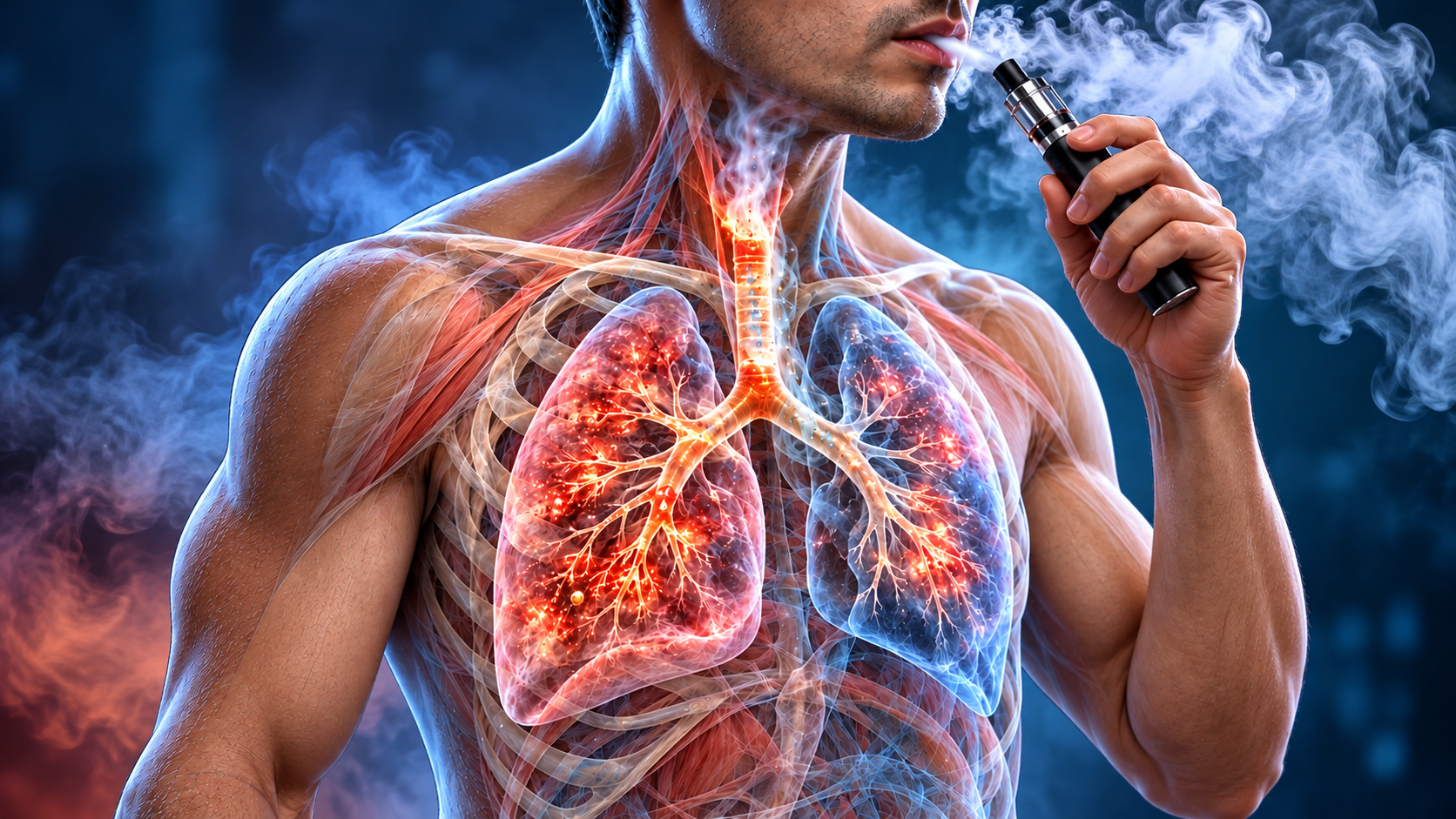
Vaping and the Lungs: What a Chest Surgeon Wants You to Know
A question that deserves a careful answer
Patients ask whether vaping is safe, and they usually receive one of two unhelpful answers: that it is harmless, or that it is just as bad as smoking. Neither is accurate, and the truth is more useful than either.
What e-cigarettes are
An e-cigarette heats a liquid into an aerosol that is inhaled. The liquid typically contains nicotine, a carrier such as propylene glycol and vegetable glycerine, and flavourings. There is no combustion of tobacco, which is the key difference — most of the several thousand harmful chemicals in cigarette smoke are products of burning.
The claim that is actually supported
The defensible statement is narrow and worth quoting precisely: for an adult smoker who switches completely to vaping, the exposure to harmful substances is substantially lower than continuing to smoke tobacco. Several health authorities support vaping as a smoking cessation aid on that basis.
Note what that statement does not say:
- It does not say vaping is harmless.
- It does not apply to people who have never smoked.
- It does not apply to young people.
- It does not apply to dual use — vaping and smoking together — which is extremely common and removes most of the benefit.
Dual use deserves emphasis, because it is where most people actually end up. A patient who reports having "mostly switched" while still smoking several cigarettes a day has not achieved the reduction described above.
What we know about harm
Established
- Nicotine addiction. Nicotine constricts blood vessels, raises heart rate and blood pressure, and is highly addictive. Some devices deliver nicotine very efficiently, and young users can become dependent quickly.
- Airway irritation — cough, throat irritation and wheeze are common.
- EVALI — a severe acute lung injury linked particularly to vitamin E acetate in illicit THC-containing products. It caused hospitalisations and deaths, and it is the clearest demonstration that what is in the liquid matters enormously. Unregulated and black-market products carry unknown contents.
- Burns and injuries from device battery failure.
- Poisoning from ingestion of liquid, particularly in young children — a genuine risk requiring safe storage.
Not yet known
This is the honest part. Cigarettes took decades of use before their link with lung cancer and cardiovascular disease was established. E-cigarettes have not been in widespread use long enough for equivalent long-term data on cancer, COPD or cardiovascular disease to exist. "No evidence of long-term harm" is not the same as "evidence of no long-term harm", and anyone who tells you the long-term risk is known is overstating the evidence in one direction or the other.
The surgical perspective
From an operative standpoint, the relevant point is that nicotine itself causes vasoconstriction and impairs wound healing, regardless of its delivery method. Nicotine from a vape, a patch, gum or a cigarette has this effect.
That is why patients are asked about vaping before surgery and not only about smoking, and why nicotine-containing products are usually stopped before operations where healing is critical. The advantage of nicotine replacement therapy during a quit attempt is that it is temporary, controlled and can be tapered — which is the relevant difference from indefinite vaping.
Vaping also does not remove the airway irritation that complicates anaesthesia and post-operative breathing. See our article on smoking and chest surgery.
Practical positions
- If you smoke tobacco — switching completely to vaping is a meaningful improvement, and better still is using it as a route to stopping nicotine altogether, with a planned end date and behavioural support.
- If you have never smoked — there is no health argument for starting. You would be acquiring an addiction and an unknown long-term risk for no benefit.
- If you are young — the developing brain is more vulnerable to nicotine dependence, and flavoured products are designed to appeal.
- If you are pregnant — nicotine in any form affects the developing baby; seek supported cessation.
- If you are facing surgery — tell your team you vape, and plan to stop with support beforehand.
- Never use unregulated or modified liquids, particularly anything containing THC obtained informally.
When to seek assessment
Breathlessness, persistent cough, chest pain, fever or weight loss in someone who vapes should be assessed medically and the vaping mentioned explicitly, since it changes how symptoms are interpreted.
Further reading
MedlinePlus: e-cigarettes, NHS: vaping to quit smoking, and the WHO tobacco fact sheet.
General education, not personal medical advice. Discuss cessation options with your doctor, particularly before surgery or during pregnancy.