الأبحاث والمنشورات
New
Article
Full-text available
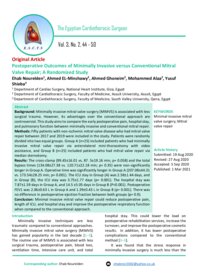
Postoperative Outcomes of Minimally Invasive versus Conventional Mitral Valve Repair; A Randomized Study
2021
The Egyptian Cardiothoracic Surgeon
Ehab Nourelden
·
Ahmed EL-Minshawy
·
Ahmed Ghoneim
·
Mohammed Alaa
·
Yusuf Shieba
Abstract
This randomised study asked a narrower question than operative safety: what does a minimally invasive approach do to pain, recovery and — importantly — lung function after mitral valve repair?
Fifty patients with non-ischaemic mitral valve disease undergoing repair between 2017 and 2019 were randomly allocated to video-assisted anterolateral mini-thoracotomy or median sternotomy.
Operative time was longer in the minimally invasive group (207 versus 174 minutes), while cross-clamp and bypass times were only nonsignificantly longer. Intensive care stay was shorter (2.6 versus 3.8 days) and hospital stay much shorter (7.9 versus 14.5 days). The clearest difference was respiratory: postoperative FEV1 was 2.06 L after mini-thoracotomy against 1.39 L after sternotomy. Ejection fraction was unchanged between groups.
That respiratory difference is the mechanism behind the shorter stay. Leaving the sternum intact preserves the mechanics of breathing, which is what allows earlier mobilisation and fewer chest complications.
Fifty patients with non-ischaemic mitral valve disease undergoing repair between 2017 and 2019 were randomly allocated to video-assisted anterolateral mini-thoracotomy or median sternotomy.
Operative time was longer in the minimally invasive group (207 versus 174 minutes), while cross-clamp and bypass times were only nonsignificantly longer. Intensive care stay was shorter (2.6 versus 3.8 days) and hospital stay much shorter (7.9 versus 14.5 days). The clearest difference was respiratory: postoperative FEV1 was 2.06 L after mini-thoracotomy against 1.39 L after sternotomy. Ejection fraction was unchanged between groups.
That respiratory difference is the mechanism behind the shorter stay. Leaving the sternum intact preserves the mechanics of breathing, which is what allows earlier mobilisation and fewer chest complications.