الأبحاث والمنشورات
New
Article
Full-text available
Short term outcome of coronary artery bypass graft surgery: Evaluation of recently established cardiac center
2018
Journal of the Egyptian Society of Cardio-Thoracic Surgery
Yusuf S.E. Khalifa
·
Karam M. Eisa
·
Mohamed Abdel Bary
·
Hossam Eldin M.M. Ismail
·
Abdallah M. Taha
Abstract
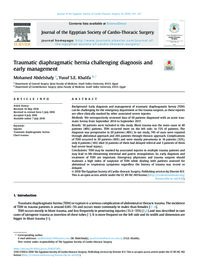
New cardiac surgery units need to know whether their results match international benchmarks. This study audited the first 100 coronary artery bypass operations performed in the cardiothoracic surgery department at Qena University Hospital.
The cohort reflected a high-risk population: 95 of 100 patients had multi-vessel disease, with diabetes in 55%, hypertension in 69%, dyslipidaemia in 55% and smoking in 58%. The left internal mammary artery was grafted to the left anterior descending artery in the majority of cases, with saphenous vein to the remaining targets. An intra-aortic balloon pump was needed in only 2%. Septicaemia was the significant complication encountered. At six months, 97% of patients were alive.
Publishing institutional results rather than relying on international figures is the point of the paper. It establishes a local baseline against which the unit can be measured, and lets surgeons and interventional cardiologists judge whether published international data actually applies to their own patients.
The cohort reflected a high-risk population: 95 of 100 patients had multi-vessel disease, with diabetes in 55%, hypertension in 69%, dyslipidaemia in 55% and smoking in 58%. The left internal mammary artery was grafted to the left anterior descending artery in the majority of cases, with saphenous vein to the remaining targets. An intra-aortic balloon pump was needed in only 2%. Septicaemia was the significant complication encountered. At six months, 97% of patients were alive.
Publishing institutional results rather than relying on international figures is the point of the paper. It establishes a local baseline against which the unit can be measured, and lets surgeons and interventional cardiologists judge whether published international data actually applies to their own patients.
New
Article
Full-text available
Traumatic diaphragmatic hernia challenging diagnosis and early management
2018
Journal of the Egyptian Society of Cardio-Thoracic Surgery
Mohamed Abdelshafy
·
Yusuf S.E. Khalifa
Abstract
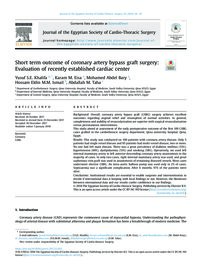
Traumatic diaphragmatic hernia is easy to miss. The injury is usually part of major trauma, and the noisier injuries alongside it draw attention away — yet a missed diaphragmatic tear can later strangulate stomach or bowel in the chest.
We retrospectively reviewed 50 patients diagnosed with acute traumatic diaphragmatic hernia between September 2014 and September 2017.
Blunt trauma accounted for 80% of cases and the left side was involved in 72%. Critically, the diagnosis was made before surgery in only 40% of patients — the majority were found at operation. Repair was abdominal in 74% and thoracic in 26%. Complications occurred in 60%, most often pneumonia (32%), and 16% died, with delayed referral or severe head injury accounting for most deaths.
The conclusion is about index of suspicion rather than technique: in any patient assessed for abdominal or respiratory symptoms after trauma — recent or long past — the diaphragm should be actively considered rather than assumed intact.
We retrospectively reviewed 50 patients diagnosed with acute traumatic diaphragmatic hernia between September 2014 and September 2017.
Blunt trauma accounted for 80% of cases and the left side was involved in 72%. Critically, the diagnosis was made before surgery in only 40% of patients — the majority were found at operation. Repair was abdominal in 74% and thoracic in 26%. Complications occurred in 60%, most often pneumonia (32%), and 16% died, with delayed referral or severe head injury accounting for most deaths.
The conclusion is about index of suspicion rather than technique: in any patient assessed for abdominal or respiratory symptoms after trauma — recent or long past — the diaphragm should be actively considered rather than assumed intact.