الأبحاث والمنشورات
New
Article
Full-text available
Ultrasound-facilitated catheter-directed thrombolysis is associated with improved survival and reduces hospital stay in acute pulmonary embolism: a propensity score-matched analysis
2026
Journal of Thoracic Disease
Ahmad G. M. N. Abdelsamad
·
Rashad Zayat
·
Yusuf Shieba
·
Alexander Kersten
·
Nikolaus Marx
·
Michael Dreher
·
Nima Hatam
·
Sebastian Kalverkamp
·
Jan Spillner
New
Article
Full-text available
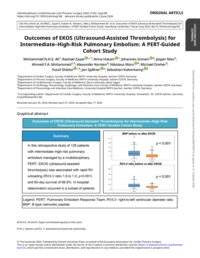
Outcomes of EKOS (Ultrasound-Assisted Thrombolysis) for Intermediate–High-Risk Pulmonary Embolism: A PERT-Guided Cohort Study
2026
Interdisciplinary CardioVascular and Thoracic Surgery
Mohammed N H E Ali
·
Rashad Zayat
·
Nima Hatam
·
Johannes Greven
·
Jasper Nies
·
Ahmed F A Mohammed
·
Alexander Kersten
·
Nikolaus Marx
·
Michael Dreher
·
Yusuf Shieba
·
Jan Spillner
·
Sebastian Kalverkamp
Abstract
Objectives Acute intermediate–high-risk pulmonary embolism (PE) is associated with right-ventricular (RV) dysfunction, biomarker elevation, and risk of early clinical deterioration. Ultrasound-assisted catheter-directed thrombolysis (USAT) using the Eko Sonic Endovascular System (EKOS) system is increasingly used in selected patients; however, real-world data on physiological response and clinically relevant in-hospital outcomes remain limited. Methods We conducted a retrospective single-centre analysis of 128 consecutive patients with acute intermediate–high-risk PE treated with EKOS-guided USAT within a structured Pulmonary Embolism Response Team (PERT) pathway between August 2017 and December 2023. Changes in RV/LV ratio, B-type natriuretic peptide (BNP), and cardiac troponin before and after intervention were assessed. A composite end-point of death, extracorporeal membrane oxygenation (ECMO), renal replacement therapy, or invasive mechanical ventilation captured clinically meaningful deterioration. Multivariable logistic regression identified determinants of the composite end-point. Results RV/LV ratio and biomarkers improved significantly after intervention. Median RV/LV ratio decreased from 1.6 to 1.0, and BNP declined from 2365 to 877 pg/mL (both P < .001). Clinically meaningful in-hospital deterioration requiring escalation of organ support occurred in a subset of patients and was predominantly associated with baseline disease severity. Short-term survival remained favourable (60-day probability 96.9%). Conclusions In this real-world, PERT-guided cohort, EKOS was associated with rapid physiological improvement and favourable short-term survival in patients with intermediate–high-risk PE. These findings should be interpreted as descriptive single-centre experience.
New
Article
Full-text available
Sex-specific echocardiographic remodeling and prognostic value of left ventricular sphericity, pressure–dimension index, and myocardial work after durable LVAD implantation
2026
Frontiers in Cardiovascular Medicine
Mahmoud Jaber
·
Ahmed F. A. Mohammed
·
Yusuf Shieba
·
Ajay Moza
·
Alish Kolashov
·
Rashad Zayat
Abstract
Background Sex-related differences in outcomes after left ventricular assist device (LVAD) implantation are recognized, yet the structural mechanisms remain incompletely defined. We evaluated sex-specific remodeling patterns and the prognostic value of ventricular geometry and non-invasive myocardial work (MW). Methods We performed a retrospective analysis of 103 adults (85 men, 18 women) undergoing durable LVAD implantation. Primary endpoints were changes in left ventricular sphericity index (LVSI) and RV pressure–dimension index (PDI) from baseline to 6 months. Adjusted models (ANCOVA with robust standard errors) and quantile regression were used to assess sex effects, with robustness examined by a 1:2 propensity score matching analysis (matching on age, BMI, clinical profile, and device). Predictors of mortality and postoperative right heart failure (RHF) were assessed using Cox and logistic regression models, respectively. Results Baseline geometry and myocardial work were similar between sexes. Post-implantation, men exhibited adverse sphericalization (median ΔLVSI +0.045, p = 0.001) and a significant decline in PDI (median Δ −1.475, p < 0.001). In contrast, women demonstrated a pattern of “geometric resistance” [defined descriptively as stable left ventricular sphericity index (ΔLVSI p = 0.766) and a non-significant change in RV pressure-dimension index (median ΔPDI −0.922, p = 0.130)], while maintaining higher absolute PDI at 6 months ( p = 0.041). While statistical significance was attenuated after 1:2 propensity-score matching, the matched-cohort estimates remained directionally consistent but imprecise: adjusted 6-month LVSI difference −0.060 (95% CI −0.189 to 0.069; p = 0.342), adjusted mean PDI difference +0.276 (95% CI −0.589 to 1.140; p = 0.510), and adjusted median PDI difference +0.828 (95% CI −0.150 to 1.806; p = 0.095). Preoperative LVSI was independently associated with mortality (HR 1.47 per SD, p = 0.034). Furthermore, preoperative global work index (GWI) was a robust independent predictor of both mortality (HR 0.14 per SD, p < 0.001) and postoperative right heart failure (OR 0.41 per SD, p = 0.022), with larger effect sizes than sex in adjusted models. Conclusion In this exploratory cohort, women showed preserved LV geometry and PDI after LVAD implantation, but findings require cautious interpretation due to small sample size and attenuation after matching. LVSI and myocardial work may support future risk stratification studies.
New
Article
Hemodynamics and Clinical Outcomes of Ultrasound-Assisted Catheter-Directed Thrombolysis in Acute Intermediate–High-Risk Pulmonary Embolism: The Aachen Experience
2026
Zentralblatt für Chirurgie - Zeitschrift für Allgemeine, Viszeral-, Thorax- und Gefäßchirurgie
R Zayat
·
S Yelenski
·
N Hatam
·
A Kersten
·
N Marx
·
M Dreher
·
Y Shieba
·
J N Nies
·
A F Mohammed
·
J Greven
·
S Kalverkamp
·
J Spillner
New
Article
Full-text available
Sex Differences in Postoperative Recovery and Mortality After High‐Risk Cardiac Surgery: A Propensity Score–Matched Post Hoc Analysis of the SUSTAIN‐CSX Trial
2026
Journal of the American Heart Association
Rashad Zayat
·
Alish Kolashov
·
Christian Stoppe
·
Quirin Notz
·
Yusuf Shieba
·
Ajay Moza
·
Daniel Catena
·
Ghaith Mohsen
·
Jan Beer
·
Georg Daniel Duerr
·
Ahmed F.A. Mohammed
Abstract
Whether women do worse than men after cardiac surgery is contested, largely because women tend to present with higher baseline risk, making raw comparisons unreliable. This analysis addressed that by matching rather than comparing crude groups.
Using data from the SUSTAIN-CSX trial (1,386 patients with complete data), women were matched 1:1 to men by age and EuroSCORE II, with exact matching on surgical category, producing 327 matched pairs.
Survival at 180 days did not differ significantly between women and men. Women had numerically longer intensive care and hospital stays, and after adjustment for residual imbalance — frailty, haemoglobin, renal disease, ejection fraction, previous infarction, preoperative medication and creatinine — female sex remained associated with longer intensive care stay (adjusted IRR 1.8) and hospital stay (adjusted IRR 1.4). Major complications were similar.
The paper is careful about what it does not show: the mortality estimates changed depending on the statistical model used, so they are reported as inconclusive rather than positive. The defensible finding is a longer recovery trajectory in women, not a difference in death.
Using data from the SUSTAIN-CSX trial (1,386 patients with complete data), women were matched 1:1 to men by age and EuroSCORE II, with exact matching on surgical category, producing 327 matched pairs.
Survival at 180 days did not differ significantly between women and men. Women had numerically longer intensive care and hospital stays, and after adjustment for residual imbalance — frailty, haemoglobin, renal disease, ejection fraction, previous infarction, preoperative medication and creatinine — female sex remained associated with longer intensive care stay (adjusted IRR 1.8) and hospital stay (adjusted IRR 1.4). Major complications were similar.
The paper is careful about what it does not show: the mortality estimates changed depending on the statistical model used, so they are reported as inconclusive rather than positive. The defensible finding is a longer recovery trajectory in women, not a difference in death.
New
Article
Full-text available
Sex-Related Differences in Prosthesis-Patient Mismatch Following Aortic Valve Replacement with Perceval Sutureless Valve
2026
Journal of Cardiovascular Development and Disease
Ali Aljalloud
·
Yusuf Shieba
·
Rashad Zayat
·
Ajay Moza
·
Ahmed Farghal Ahmed Mohammed
Abstract
Women have smaller aortic roots than men, so a valve that performs adequately in a man may be functionally too small in a woman — prosthesis–patient mismatch, which impairs recovery of the left ventricle. Sutureless valves offer a larger effective orifice for a given annulus, and this study asked whether that closes the gap.
We retrospectively analysed 139 patients (68 men, 71 women) undergoing Perceval sutureless aortic valve replacement between 2016 and 2020, grading mismatch by indexed effective orifice area under VARC-3 criteria and stratifying by body mass index.
Mismatch occurred in 74.6% of women against 22.1% of men, and the gap persisted among non-obese patients (47.9% versus 16.2%). Women received smaller valves and had lower indexed orifice areas despite comparable gradients; postoperatively they had lower indexed orifice area but higher ejection fraction. Early clinical outcomes were similar, and most mismatch was moderate.
The conclusion is that favourable sutureless haemodynamics do not overcome anatomical sex differences. Tailored strategies — aortic root enlargement, and sex-specific orifice-area thresholds — may improve valve selection for women.
We retrospectively analysed 139 patients (68 men, 71 women) undergoing Perceval sutureless aortic valve replacement between 2016 and 2020, grading mismatch by indexed effective orifice area under VARC-3 criteria and stratifying by body mass index.
Mismatch occurred in 74.6% of women against 22.1% of men, and the gap persisted among non-obese patients (47.9% versus 16.2%). Women received smaller valves and had lower indexed orifice areas despite comparable gradients; postoperatively they had lower indexed orifice area but higher ejection fraction. Early clinical outcomes were similar, and most mismatch was moderate.
The conclusion is that favourable sutureless haemodynamics do not overcome anatomical sex differences. Tailored strategies — aortic root enlargement, and sex-specific orifice-area thresholds — may improve valve selection for women.
Article
Full-text available
Hemocompatibility and Long-Term Outcomes in HeartWare Versus HeartMate II Versus HeartMate 3: Multicenter Real-World Cohort
2026
Artificial Organs
Hamza H. H. Ben Nasir
·
Ahmed F. A. Mohammed
·
Omar Allham
·
Alish Kolashov
·
Yusuf Shieba
·
Lachmandath Tewarie
·
Bernd Panholzer
·
Ajay Moza
·
Assad Haneya
·
Rashad Zayat
Abstract
Left ventricular assist devices keep patients alive in advanced heart failure, but their long-term problems are dominated by how the pump interacts with blood — pump thrombosis, ischaemic stroke and major bleeding. This multicentre study compared three generations of device in ordinary clinical practice rather than trial conditions.
We followed 327 adult recipients: 112 HeartWare (HVAD), 142 HeartMate II, and 73 HeartMate 3. Survival was analysed by Kaplan–Meier and Cox models, and blood-compatibility events were assessed with competing-risk methods that treat death as a competing event rather than ignoring it.
The third-generation centrifugal HeartMate 3 showed better long-term survival than both the axial-flow HeartMate II and the centrifugal HVAD, together with a lower burden of haemocompatibility-related adverse events across follow-up.
The finding supports the shift toward fully magnetically levitated pump design, and illustrates why competing-risk analysis matters in this population: patients who die cannot go on to have a stroke, and conventional methods overstate event rates if that is not accounted for.
We followed 327 adult recipients: 112 HeartWare (HVAD), 142 HeartMate II, and 73 HeartMate 3. Survival was analysed by Kaplan–Meier and Cox models, and blood-compatibility events were assessed with competing-risk methods that treat death as a competing event rather than ignoring it.
The third-generation centrifugal HeartMate 3 showed better long-term survival than both the axial-flow HeartMate II and the centrifugal HVAD, together with a lower burden of haemocompatibility-related adverse events across follow-up.
The finding supports the shift toward fully magnetically levitated pump design, and illustrates why competing-risk analysis matters in this population: patients who die cannot go on to have a stroke, and conventional methods overstate event rates if that is not accounted for.

Article
Full-text available
Sex-Related Differences in Prosthesis-Patient Mismatch Following Aortic Valve Replacement with Perceval Sutureless Valve
2026
Journal of Cardiovascular Development and Disease
Ali Aljalloud
·
Yusuf Shieba
·
Rashad Zayat
·
Ajay Moza
·
Ahmed Farghal Ahmed Mohammed
Abstract
Women have smaller aortic roots than men, so a replacement valve that performs well in a man can still be functionally too small in a woman — a problem called prosthesis–patient mismatch, which holds back recovery of the left ventricle. Sutureless valves give a larger opening area for a given annulus size, and this study asked whether that advantage is enough to close the gap between the sexes.
We reviewed 139 patients (68 men, 71 women) who received a Perceval sutureless aortic valve between 2016 and 2020, grading mismatch by indexed effective orifice area under VARC-3 criteria.
Mismatch was far more common in women than men (74.6% versus 22.1%). The difference persisted in non-obese patients, where body size cannot explain it away (47.9% versus 16.2%). Women received smaller valves and had consistently lower indexed orifice areas despite similar pressure gradients. Early clinical outcomes were nonetheless comparable between the sexes, and most mismatch was moderate rather than severe.
The practical message is that a sutureless valve does not by itself solve the anatomical problem. Planning for women may need to include root enlargement, and the thresholds used to define mismatch may themselves need to be sex-specific.
We reviewed 139 patients (68 men, 71 women) who received a Perceval sutureless aortic valve between 2016 and 2020, grading mismatch by indexed effective orifice area under VARC-3 criteria.
Mismatch was far more common in women than men (74.6% versus 22.1%). The difference persisted in non-obese patients, where body size cannot explain it away (47.9% versus 16.2%). Women received smaller valves and had consistently lower indexed orifice areas despite similar pressure gradients. Early clinical outcomes were nonetheless comparable between the sexes, and most mismatch was moderate rather than severe.
The practical message is that a sutureless valve does not by itself solve the anatomical problem. Planning for women may need to include root enlargement, and the thresholds used to define mismatch may themselves need to be sex-specific.
